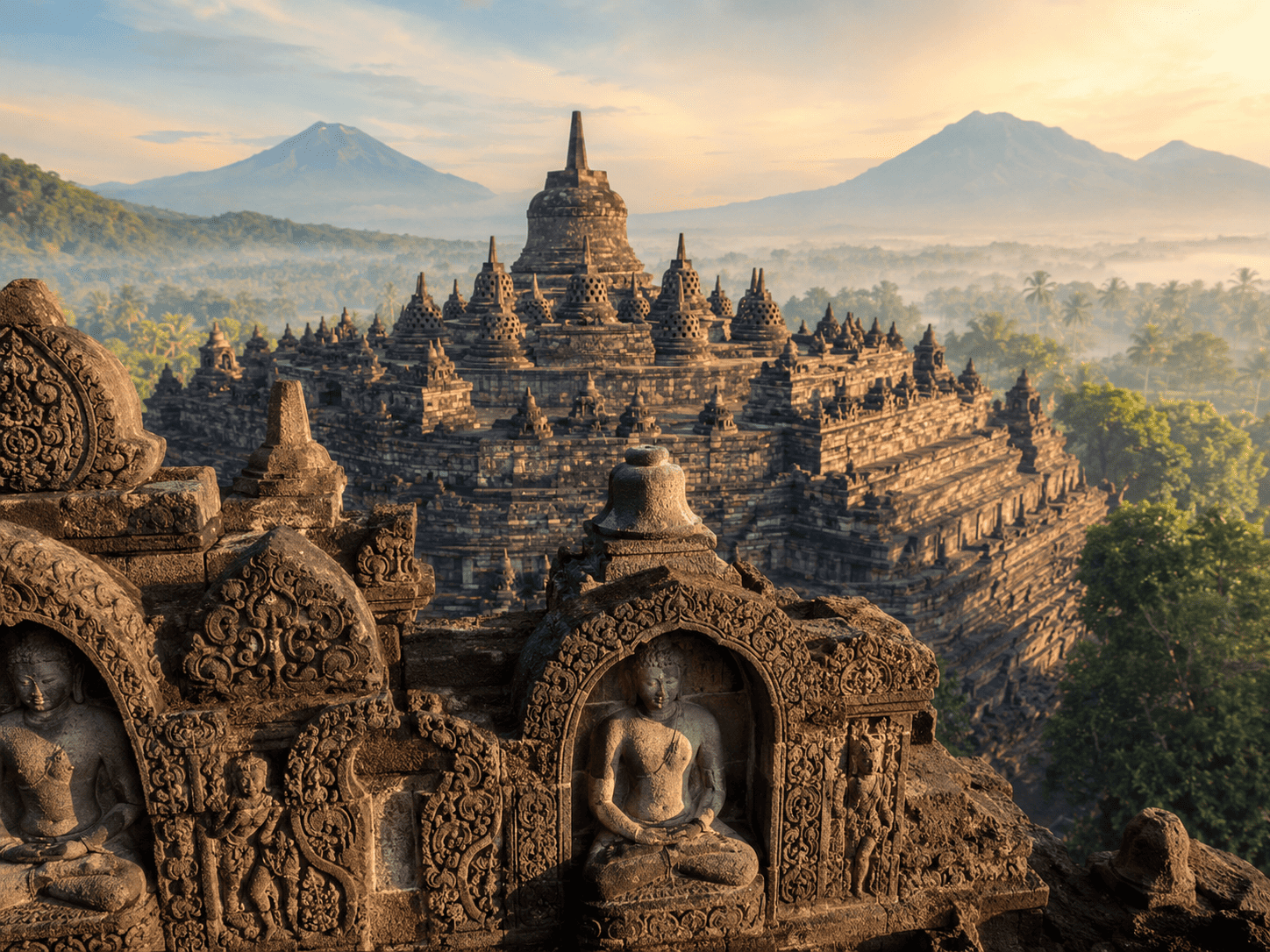
Borobudur is one of Indonesia’s most remarkable cultural landmarks. These Borobudur Temple Interesting Facts reveal why the monument attracts travelers, historians, and Buddhist pilgrims worldwide. Its scale, reliefs, Buddha statues, stupas, and conservation history make it far more than a beautiful photo location.
Borobudur Is More Than 1,100 Years Old
Builders created Borobudur during the eighth and ninth centuries under the Syailendra Dynasty. Indonesia Travel places its construction at around 780 to 840 AD.
That timeline means Borobudur has stood in Central Java for more than eleven centuries. Its survival becomes even more impressive when you consider tropical rain, earthquakes, volcanic activity, and political change.
The Monument Contains Thousands of Relief Panels
Borobudur contains about 2,672 relief panels. These carvings cover Buddhist teachings, moral stories, daily life, animals, transportation, buildings, and many other subjects.
UNESCO also records around 2,520 square meters of decorated relief surfaces. Visitors who rush directly to the upper terraces can miss much of this visual storytelling.
For a deeper explanation, read our guide to important facts about Borobudur Temple. It explores the monument’s history, architecture, Buddhist meaning, reliefs, and other unique details.
Borobudur Originally Had 504 Buddha Statues
Another striking fact involves the Buddha images. Borobudur originally contained around 504 Buddha statues across its different levels.
Their positions and hand gestures carry symbolic meanings. The statues therefore form part of the monument’s religious design rather than serving only as decoration.
Some statues have lost parts over the centuries. However, the surviving images still shape Borobudur’s visual and spiritual identity.
There Are 72 Openwork Stupas
The upper circular platforms contain 72 openwork stupas. Each one holds a Buddha image inside.
These stupas create one of Borobudur’s most recognizable views. Their repeating shapes also support the temple’s Buddhist symbolism. As visitors climb higher, the architecture becomes more open and simple.
A large central stupa crowns the monument and creates a clear focus at the highest level.
Borobudur Represents Three Spiritual Realms
Borobudur’s vertical design reflects three realms in Buddhist cosmology. Kamadhatu represents desire, Rupadhatu represents form, and Arupadhatu represents formlessness.
The architecture changes across these levels. Detailed galleries dominate the lower sections, while circular platforms and stupas define the upper area.
This design turns the climb into a symbolic spiritual journey.
Borobudur Was Rediscovered in the Nineteenth Century
Borobudur lost its major religious role for centuries. In 1814, Thomas Stamford Raffles received reports about the monument and sent H.C. Cornelius to investigate it.
Cornelius and local workers cleared vegetation and soil from the site. Their work helped bring Borobudur into wider archaeological attention.
Later conservation projects protected the structure from further damage.
UNESCO Recognized Borobudur in 1991
UNESCO added the Borobudur Temple Compounds to the World Heritage List in 1991. The property includes Borobudur, Mendut, and Pawon temples.
UNESCO recognizes the site for its architecture, artistic influence, and Buddhist significance. A major Indonesia-UNESCO restoration project from 1973 to 1983 also helped secure the monument’s future.
Travelers who want to understand these details in person can choose a private Borobudur tour from Yogyakarta. A local guide can explain the reliefs, architecture, Buddha images, and spiritual meaning.
Conclusion
These Borobudur Temple Interesting Facts show how much history and symbolism exist within the monument. Its 2,672 relief panels, 504 original Buddha statues, 72 openwork stupas, and three spiritual realms create a complex cultural story.
Borobudur also survived centuries of decline and major conservation challenges. Understanding these details can make a visit far more meaningful than simply seeing its famous silhouette.